

Data Center Accelerator Market Set for Explosive Expansion, Reaching USD 49.52 Billion by 2035
Data Center Accelerator Market
Data Center Accelerator Market Size, Share and Research Report By Accelerator Type (Graphics Processing Units (GPUs), Field Programmable Gate Arrays (FPGAs)
The data center accelerator market is expanding as organizations deploy specialized hardware to enhance AI, machine learning, and high-performance computing workloads.”
NEW YORK,, CA, UNITED STATES, June 15, 2026 /EINPresswire.com/ -- The global Data Center Accelerator Market is undergoing a massive transformation, driven by an increasing enterprise demand for high-performance computing, the rapid proliferation of artificial intelligence (AI) workloads, and accelerated cloud infrastructure deployment across global digital enterprise ecosystems. Blending advanced GPU/TPU processing logic with predictive AI modeling and edge computing connectivity, the market is poised for explosive growth over the next decade.— Market Research Future (MRFR)
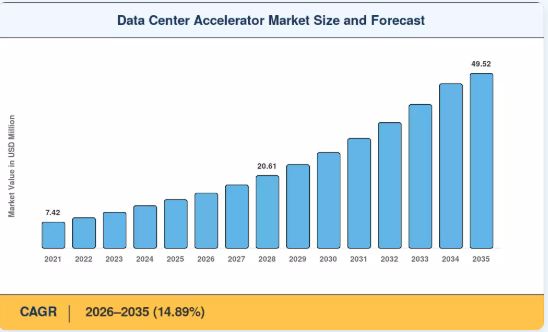
The global Data Center Accelerator Market size is expected to surge from its foundational base, riding a wave of robust Compound Annual Growth Rate (CAGR) driven by specialized silicon innovation and deep learning infrastructure expansion. The data center accelerator market reached an estimated USD 13.79 billion in 2025 and is forecast to climb from USD 15.68 billion in 2026 to USD 49.52 billion by 2035, registering a CAGR of 14.89% across the forecast window.
Get Full PDF Sample Copy of Report: (Including Full TOC, List of Tables & Figures, Chart) @
https://www.marketresearchfuture.com/sample_request/24614
Key Drivers Fueling Market Growth
The convergence of three distinct technological and economic pillars is accelerating the expansion of the data center accelerator market:
Rise of AI and Machine Learning Workloads: The surge in generative AI, deep learning model training, and inference deployment is fundamentally reshaping data center infrastructure requirements. Modern hyperscale facilities utilize GPU clusters, Tensor Processing Units (TPUs), and Field-Programmable Gate Arrays (FPGAs) to optimize neural network computations, dramatically reducing time-to-insight for organizations and enabling real-time decision-making at unprecedented computational speed.
Expansion of Cloud Computing and Edge Infrastructure: Global enterprises and hyperscale cloud providers including AWS, Microsoft Azure, and Google Cloud — are aggressively deploying accelerated compute nodes to support virtualized workloads, container orchestration, and distributed AI inference at scale. Integrated 5G, cloud-native frameworks, and edge computing allow accelerators to deliver ultra-low latency processing, real-time hazard detection, and cross-network workload optimization across geographically distributed environments.
Focus on Energy Efficiency and Sustainable Computing: With rising energy costs and mounting ESG pressures on enterprise operators, the digital computing segment is leveraging next-generation accelerator architectures to maximize performance-per-watt ratios. The integration of custom silicon design, liquid cooling compatibility, and power-aware scheduling allows hyperscale operators to deliver unique, authentic high-throughput compute environments while minimizing Power Usage Effectiveness (PUE) a benchmark that traditional CPU-only infrastructures cannot replicate.
Market Segmentation Analysis
To provide a granular understanding of the landscape, global market research highlights a comprehensive segmentation across several key domains:
1. By Processor Type
Graphics Processing Units (GPUs): The dominant segment, widely deployed across AI training, scientific simulation, and high-performance rendering workloads in hyperscale data centers globally.
Tensor Processing Units (TPUs): Custom ASICs engineered specifically for matrix multiplication and neural network inference, rapidly gaining traction due to superior efficiency in specialized AI tasks.
Field-Programmable Gate Arrays (FPGAs): Reconfigurable hardware solutions enabling real-time data stream processing, network function virtualization, and low-latency inference for financial and telecom applications.
Central Processing Units (CPUs): Advanced multi-core processors serving as primary orchestration engines in hybrid accelerated computing environments alongside GPUs and FPGAs.
2. By Data Center Type
Hyperscale Data Centers: Massive infrastructure deployments operated by cloud giants, consuming the largest share of accelerator silicon for AI training, large language model hosting, and distributed cloud services.
Colocation Data Centers: Third-party managed facilities increasingly adopting accelerators to serve enterprise clients requiring dedicated AI and analytics processing capacity without capital-intensive builds.
Edge Data Centers: Compact, distributed compute facilities deployed near end-users to support latency-sensitive applications including autonomous vehicles, AR/VR, and IoT analytics platforms.
3. By Application
Machine Learning & Deep Learning: The leading application segment, encompassing training of large-scale neural networks, natural language processing models, and computer vision systems.
Big Data Analytics: Accelerated query processing and real-time data pipeline execution across structured and unstructured enterprise datasets at petabyte scale.
High Performance Computing (HPC): Scientific simulation, genomics research, climate modeling, and computational fluid dynamics leveraging massively parallel accelerator architectures.
Video Streaming & Transcoding: GPU-accelerated encoding and real-time video processing supporting content delivery networks and OTT streaming platforms at global scale.
Get access to the full description of the report @ https://www.marketresearchfuture.com/reports/data-center-accelerator-market-24614
Regional Insights
North America: Currently holds a highly dominant market share in the global landscape. This leadership is sustained by the presence of major hyperscale operators including AWS, Microsoft, Google, and Meta, high AI investment rates, and robust venture-backed semiconductor innovation ecosystems concentrated in Silicon Valley and broader U.S. tech corridors.
Asia-Pacific: Anticipated to register the fastest growth rate throughout the forecast period. Rapid enterprise digitization, massive government-backed AI infrastructure initiatives, and expanding data center build-out activity across technologically intensive commercial hubs like China, Japan, South Korea, and India are fueling this hyper-growth. China's state-driven AI acceleration programs and Japan's supercomputing investments are particularly transformative.
Europe: Demonstrating steady growth underpinned by GDPR-compliant data sovereignty requirements, Green Deal-aligned energy efficiency mandates, and increasing adoption of AI-accelerated workloads across financial services, automotive R&D, and pharmaceutical research sectors in Germany, the UK, and the Netherlands.
Top Key Companies
The global landscape is highly consolidated around critical silicon providers, cloud infrastructure leaders, and specialized AI hardware innovators, which include:
★NVIDIA (US): The dominant global leader in GPU-accelerated computing, powering the vast majority of AI training infrastructure through its H100/B100 Hopper and Blackwell GPU architectures deployed across hyperscale data centers worldwide.
★AMD (US): A rapidly scaling competitor delivering high-performance Instinct MI300X accelerators, challenging NVIDIA across HPC and AI inference workloads in enterprise and cloud environments.
★Intel (US): A global leader combining Gaudi AI accelerators with Xeon CPU platforms to serve mixed-workload enterprise data centers and cloud-native AI deployment pipelines.
★Google (US): A pioneer in custom accelerator silicon through its Tensor Processing Unit (TPU) program, powering internal AI services and offering TPU cloud instances via Google Cloud Platform.
★Amazon (US): An innovator deploying proprietary Trainium and Inferentia accelerators within AWS cloud infrastructure, enabling cost-optimized AI training and inference at hyperscale.
★Microsoft (US): A major cloud provider deeply integrating NVIDIA GPU capacity and developing Azure Maia custom AI accelerators to power Microsoft 365 Copilot and Azure OpenAI Service deployments.
★IBM (US): A veteran enterprise solutions provider combining AI accelerator platforms with hybrid cloud architecture to serve regulated industries including financial services and healthcare.
★Alibaba (CN): A scaling cloud hyperscaler deploying Hanguang AI inference accelerators across Alibaba Cloud to power e-commerce, logistics optimization, and enterprise AI services in Asia-Pacific.
★Huawei (CN): A major telecommunications and computing innovator deploying Ascend AI processors and Atlas accelerator platforms across Chinese enterprise and government data center deployments.
Emerging Trends and Future Outlook
The future of the data center accelerator market lies in the breakdown of silos between large-scale AI model training and real-time inference deployment at the edge. Industry leaders are focusing on creating cohesive silicon ecosystems where a commercial operator doesn't just purchase processing capacity, but continuously generates workload telemetry via intelligent orchestration platforms to optimize their next infrastructure procurement cycle.
This data simultaneously allows semiconductor vendors to refine silicon roadmaps and proactively address thermal and power constraints before they become systemic bottlenecks in dense GPU clusters.
As multi-modal AI architectures and sovereign cloud frameworks continue to merge with decentralized edge computing deployments, secure and automated workload migration, verifiable model inference latency benchmarks, and energy-transparent compute billing will become standard benchmarks ensuring that the data center accelerator market remains highly accurate, fast-responding, and structurally resilient against global compute demand surges driven by next-generation AI breakthroughs.
FAQs
Q – How does the rise of generative AI impact the total addressable market for data center accelerators?
Ans – Generative AI workloads including large language model training and real-time inference for conversational AI applications require GPU and TPU compute densities approximately 10x to 100x greater than traditional analytics workloads. Over a multi-year horizon, this exponential compute demand expansion vastly increases accelerator procurement budgets, enabling semiconductor vendors to justify aggressive silicon investment cycles that progressively lower cost-per-FLOP for all enterprise adopters.
Q – What core methodologies should infrastructure operators evaluate before deploying specialized AI accelerators?
Ans – Operators must analyze workload-specific performance benchmarks (training throughput vs. inference latency), evaluate total cost of ownership across power consumption and cooling infrastructure, and rigorously assess software ecosystem maturity including framework compatibility with PyTorch, TensorFlow, and proprietary compiler stacks before committing to large-scale accelerator deployments in production data center environments.
➤➤ Discover More Insights with Market Research Future:
Mobile Banking Market-
https://www.marketresearchfuture.com/reports/mobile-banking-market-2906
4K Technology Market-
https://www.marketresearchfuture.com/reports/4k-technology-market-2909
Virtual Reality In Gaming Market-
https://www.marketresearchfuture.com/reports/virtual-reality-gaming-market-2967
4K Camera Market-
https://www.marketresearchfuture.com/reports/4k-camera-market-2994
Mobile Video Surveillance Market-
https://www.marketresearchfuture.com/reports/mobile-video-surveillance-market-3023
Ball Valves Market-
https://www.marketresearchfuture.com/reports/ball-valves-market-3349
Smart Mirror Market-
https://www.marketresearchfuture.com/reports/smart-mirrors-market-3505
Waterproof Bluetooth Speakers Market-
https://www.marketresearchfuture.com/reports/waterproof-bluetooth-speakers-market-3508
Hazardous Area Equipment Market-
https://www.marketresearchfuture.com/reports/hazardous-area-equipment-market-3680
M2M Connections Market-
https://www.marketresearchfuture.com/reports/machine-2-machine-connections-market-3818
As-Interface Market-
https://www.marketresearchfuture.com/reports/actuator-sensor-interface-market-3820
Sagar Kadam
Market Research Future
+ +1 628-258-0071
email us here
Visit us on social media:
LinkedIn
Facebook
X
Legal Disclaimer:
EIN Presswire provides this news content "as is" without warranty of any kind. We do not accept any responsibility or liability for the accuracy, content, images, videos, licenses, completeness, legality, or reliability of the information contained in this article. If you have any complaints or copyright issues related to this article, kindly contact the author above.
