

Global Software Localization Market Growth Fueled by Cloud and AI Technologies
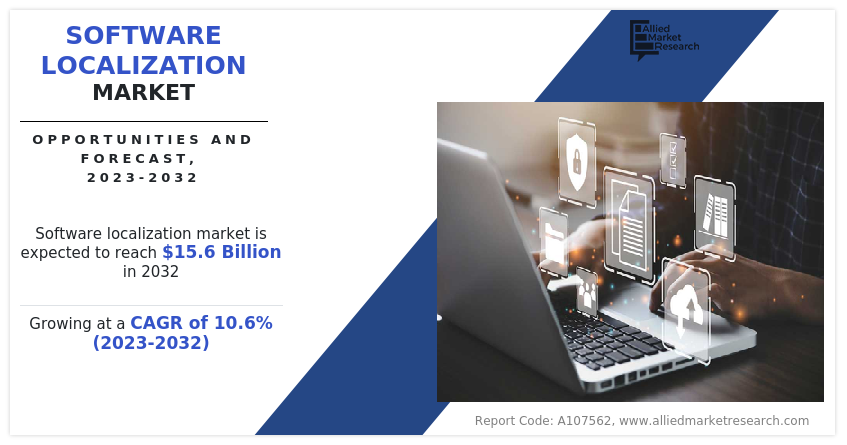
Software localization market is projected to reach $15.6 billion by 2032 driven by AI, cloud, and app globalization.
Rising demand for multilingual software and AI-powered translation tools boosts software localization market growth.”
WILMINGTON, DE, UNITED STATES, May 29, 2026 /EINPresswire.com/ -- — Allied Market Research
According to a new report published by Allied Market Research, the software localization market size was valued at $5.9 billion in 2022 and is projected to reach $15.6 billion by 2032, growing at a CAGR of 10.6% from 2023 to 2032. The growing demand for multilingual software applications, rising global digital transformation, and rapid advancements in artificial intelligence and machine translation technologies are significantly driving the expansion of the software localization market worldwide.
Download PDF Brochure: https://www.alliedmarketresearch.com/request-sample/A107562
Software localization has become an essential process for businesses aiming to expand their digital presence across international markets. Localization software enables organizations to translate, adapt, and optimize software products, websites, applications, and digital content according to the language, culture, and preferences of specific regions. As businesses increasingly target global customers, the need for accurate and culturally relevant localization solutions continues to rise.
The increasing adoption of smartphones, digital applications, cloud platforms, and e-commerce solutions has accelerated the need for software localization services across industries. Businesses are focusing on providing seamless multilingual experiences to users to improve customer engagement, increase brand loyalty, and expand their international market reach.
Growing Demand for Multilingual Digital Experiences
The rapid expansion of digital platforms and global online services has significantly increased the demand for software localization solutions. Modern businesses operate in highly competitive international markets where customers expect personalized and localized digital experiences. Companies are increasingly investing in localization technologies to adapt software products and applications for different languages and cultural environments.
Software localization helps organizations improve customer satisfaction by enabling users to interact with applications and platforms in their preferred languages. This enhances accessibility, usability, and customer engagement while supporting global business expansion strategies.
The growing popularity of mobile applications has also contributed to the rising demand for localization services. Businesses are increasingly localizing mobile apps to reach non-English-speaking users and strengthen their market presence in international regions. Mobile app localization has become critical for gaming, e-commerce, healthcare, education, finance, and entertainment applications.
Furthermore, organizations are leveraging localization platforms to optimize websites, user interfaces, product documentation, customer support systems, and digital marketing campaigns. As globalization continues to reshape the business landscape, software localization is becoming a key competitive advantage for enterprises worldwide.
Artificial Intelligence Revolutionizing Software Localization
Artificial intelligence and machine learning technologies are transforming the software localization market by improving translation speed, accuracy, and operational efficiency. AI-powered localization tools can automate repetitive translation tasks, manage translation memory systems, and streamline multilingual content workflows.
Machine translation technologies have advanced significantly in recent years, enabling businesses to process large volumes of multilingual content more efficiently. While human expertise remains essential for maintaining linguistic and cultural accuracy, AI-driven systems help reduce localization costs and improve turnaround times.
Natural language processing technologies are also helping localization providers deliver context-aware translations that improve user experiences. AI-powered tools can analyze customer behavior, language patterns, and regional preferences to optimize localized content more effectively.
Businesses are increasingly integrating AI-based localization platforms into agile software development environments. These integrations enable continuous localization processes where software updates, content changes, and new features are translated and deployed simultaneously across multiple languages.
The growing adoption of AI-driven localization solutions is expected to accelerate innovation and efficiency within the software localization market during the forecast period.
Agile Development and Continuous Localization Driving Market Growth
The increasing adoption of agile software development methodologies is reshaping the localization industry. Agile development emphasizes continuous updates, collaboration, and faster software releases, requiring localization teams to operate within shorter development cycles.
Continuous localization has emerged as a critical strategy for organizations developing multilingual software applications. This approach integrates localization directly into the software development lifecycle, allowing translations and updates to occur in real time.
Businesses are increasingly adopting cloud-based translation management systems to support agile localization workflows. These systems enable developers, translators, and project managers to collaborate more effectively while improving workflow transparency and operational efficiency.
Continuous localization also helps businesses reduce time-to-market for global software releases. Companies can launch localized applications simultaneously across multiple regions, improving competitiveness and enhancing customer experiences.
As agile software development continues to gain popularity across industries, the demand for scalable and automated localization solutions is expected to increase significantly.
Cloud-Based Localization Platforms Enhancing Efficiency
Cloud computing technologies are playing an increasingly important role in the software localization market. Cloud-based localization platforms provide businesses with centralized systems for managing multilingual content, translation workflows, and localization assets.
These platforms offer scalability, flexibility, remote accessibility, and cost-efficiency, making them attractive for businesses of all sizes. Cloud-based systems also enable organizations to collaborate with global translation teams and localization vendors more effectively.
Companies are increasingly adopting cloud localization platforms to manage websites, mobile apps, software interfaces, and customer support content across multiple languages. Real-time access to translation data and analytics helps organizations optimize localization strategies and improve project management.
Small and medium-sized enterprises are particularly benefiting from cloud-based localization solutions due to their lower implementation costs and simplified deployment processes. This trend is expected to support broader adoption of localization technologies during the forecast period.
Procure This Report (248 Pages PDF with Insights, Charts, Tables, and Figures): https://www.alliedmarketresearch.com/software-localization-market/purchase-options
Large Enterprises Lead Software Localization Adoption
Based on end users, the large enterprises segment dominated the software localization market in 2022. Large organizations operate across multiple countries and require advanced localization solutions to manage multilingual software products and digital services efficiently.
These enterprises generate significant volumes of digital content and frequently release software updates, making automated localization tools essential for maintaining operational efficiency. Large businesses are increasingly investing in AI-driven translation technologies, localization automation, and cloud-based content management systems.
In addition, large enterprises are integrating localization workflows with DevOps practices and agile development environments to accelerate product releases and improve global customer engagement.
However, small and medium-sized enterprises are expected to witness the highest growth during the forecast period. SMEs are increasingly recognizing the importance of localization for expanding into international markets and improving customer experiences.
Affordable cloud-based translation management platforms and AI-powered localization tools are enabling SMEs to access advanced localization capabilities without significant infrastructure investments. This trend is expected to drive substantial growth opportunities for localization service providers.
Translation Management Software Segment Dominates Market
By type, the translation management software segment accounted for the highest revenue share in 2022. Translation management platforms help organizations streamline multilingual content workflows, automate project management tasks, and improve translation quality.
These platforms provide centralized systems for managing translation memories, terminology databases, workflow automation, and collaboration tools. Businesses use translation management software to improve consistency, reduce operational costs, and accelerate software localization processes.
The increasing demand for real-time multilingual communication and continuous software updates is driving adoption of advanced translation management systems. AI integration, machine learning capabilities, and cloud deployment models are further improving the functionality and efficiency of these platforms.
As digital transformation accelerates globally, translation management software is expected to remain a critical component of the software localization market.
North America Dominates Global Software Localization Market
North America accounted for the highest market share in the software localization market in 2022. The region’s strong digital infrastructure, high technology adoption rates, and presence of major software companies are key factors driving market growth.
Organizations across the U.S. and Canada are increasingly investing in multilingual software platforms, AI-driven localization technologies, and cloud-based translation solutions to support international business operations.
North American businesses are also placing greater emphasis on software quality assurance and localization testing processes. Companies are investing in linguistic testing, functional testing, and compatibility testing to ensure high-quality user experiences across global markets.
Major technology providers such as IBM, Microsoft, Google, and Lionbridge Technologies are continuously expanding localization capabilities through innovation, partnerships, and AI integration.
However, Asia-Pacific is expected to witness the fastest growth during the forecast period. Rapid digitalization, increasing internet penetration, expanding mobile user bases, and growing e-commerce industries are fueling demand for localized software solutions across the region.
Countries including China, India, Japan, and South Korea are experiencing significant growth in software localization adoption due to rising digital transformation initiatives and multilingual consumer markets.
COVID-19 Impact Accelerated Global Localization Demand
The COVID-19 pandemic moderately impacted the software localization market while also creating new growth opportunities. During the pandemic, businesses rapidly expanded digital operations and increased online engagement with international customers.
The shift toward remote work, online services, virtual communication, and digital commerce significantly increased demand for localized software applications and multilingual content. Businesses recognized the importance of localization for reaching global audiences and maintaining operational continuity.
However, the pandemic also introduced challenges for localization providers. The need for rapid translation of COVID-19-related content required specialized expertise and accelerated turnaround times. Localization teams faced operational disruptions due to remote work transitions and reduced industry networking opportunities.
Despite these challenges, the pandemic accelerated investment in AI-powered translation systems, cloud-based localization platforms, and digital collaboration tools. These developments are expected to continue supporting market growth in the post-pandemic environment.
Technological Innovations Reshaping Localization Services
Emerging technologies are significantly transforming the future of the software localization market. Artificial intelligence, machine learning, natural language processing, cloud computing, and automation technologies are improving translation quality and operational efficiency.
Businesses are increasingly adopting automated content extraction systems, AI-based linguistic quality assurance tools, and predictive translation technologies to streamline localization workflows. These innovations help organizations reduce costs, improve scalability, and accelerate multilingual content delivery.
In addition, companies are investing in 3D localization, voice translation technologies, augmented reality interfaces, and immersive digital experiences to support next-generation software applications.
Strategic partnerships are also playing an important role in market development. For example, in April 2023, Phrase partnered with Lionbridge to integrate advanced localization capabilities into enterprise translation and language management solutions. Such collaborations are helping companies expand technological capabilities and improve customer experiences globally.
Get a Customized Research Report: https://www.alliedmarketresearch.com/request-for-customization/A107562
Competitive Landscape and Future Outlook
The software localization market remains highly competitive, with major players focusing on AI integration, cloud expansion, strategic partnerships, and localization automation technologies to strengthen market positions.
Key companies operating in the software localization market include IBM, Microsoft, Lionbridge Technologies LLC, SDL/Trados, Google, SYSTRAN, Babylon Corporation, The Babel Fish Corporation, Argos Multilingual, and Alchemy Software Development Ltd.
These companies are continuously investing in research and development activities to improve translation accuracy, workflow automation, and multilingual software deployment capabilities.
The future of the software localization market appears highly promising as globalization, digital transformation, and multilingual communication continue expanding across industries. Businesses are increasingly recognizing localization as a critical strategy for improving customer engagement, accelerating international expansion, and strengthening competitive positioning.
The integration of AI, cloud computing, agile development methodologies, and automation technologies is expected to reshape the localization industry over the next decade. As organizations continue investing in global digital experiences, the software localization market is projected to witness substantial innovation and long-term growth through 2032.
Trending Reports in Energy and Power Industry:
Software Localization Market
https://www.alliedmarketresearch.com/software-localization-market-A107562
Storage Management Software Market
https://www.alliedmarketresearch.com/storage-management-software-market-A115204
Sales Training Software Market
https://www.alliedmarketresearch.com/sales-training-software-market-A325805
Software Localization Market
https://www.alliedmarketresearch.com/software-localization-market-A107562
Database Monitoring Software Market
https://www.alliedmarketresearch.com/database-monitoring-software-market-A31715
Feedback Management Software Market
https://www.alliedmarketresearch.com/feedback-management-software-market-A31569
Video Game Software Market
https://www.alliedmarketresearch.com/video-game-software-market-A31488
Construction Management Software Market
https://www.alliedmarketresearch.com/construction-management-software-market-A06978
Label Printing Software Market
https://www.alliedmarketresearch.com/label-printing-software-market-A31336
About Us
Allied Market Research (AMR) is a full-service market research and business-consulting wing of Allied Analytics LLP based in Portland, Oregon. Allied Market Research provides global enterprises as well as medium and small businesses with unmatched quality of "Market Research Reports" and "Business Intelligence Solutions." AMR has a targeted view to provide business insights and consulting to assist its clients to make strategic business decisions and achieve sustainable growth in their respective market domain.
Pawan Kumar, the CEO of Allied Market Research, is leading the organization toward providing high-quality data and insights. We are in professional corporate relations with various companies and this helps us in digging out market data that helps us generate accurate research data tables and confirms utmost accuracy in our market forecasting. Each and every data presented in the reports published by us is extracted through primary interviews with top officials from leading companies of domain concerned. Our secondary data procurement methodology includes deep online and offline research and discussion with knowledgeable professionals and analysts in the industry.
David Correa
Allied Market Research
+ + + + + + + + + + + + +1 800-792-5285
email us here
Visit us on social media:
LinkedIn
Facebook
YouTube
X
Legal Disclaimer:
EIN Presswire provides this news content "as is" without warranty of any kind. We do not accept any responsibility or liability for the accuracy, content, images, videos, licenses, completeness, legality, or reliability of the information contained in this article. If you have any complaints or copyright issues related to this article, kindly contact the author above.
