

Vadzo Imaging Introduces Vajra-821CRS 4K HDR Camera Powered by USB 3.2 Gen 2×2 Ultra Fast 20Gbps Interface
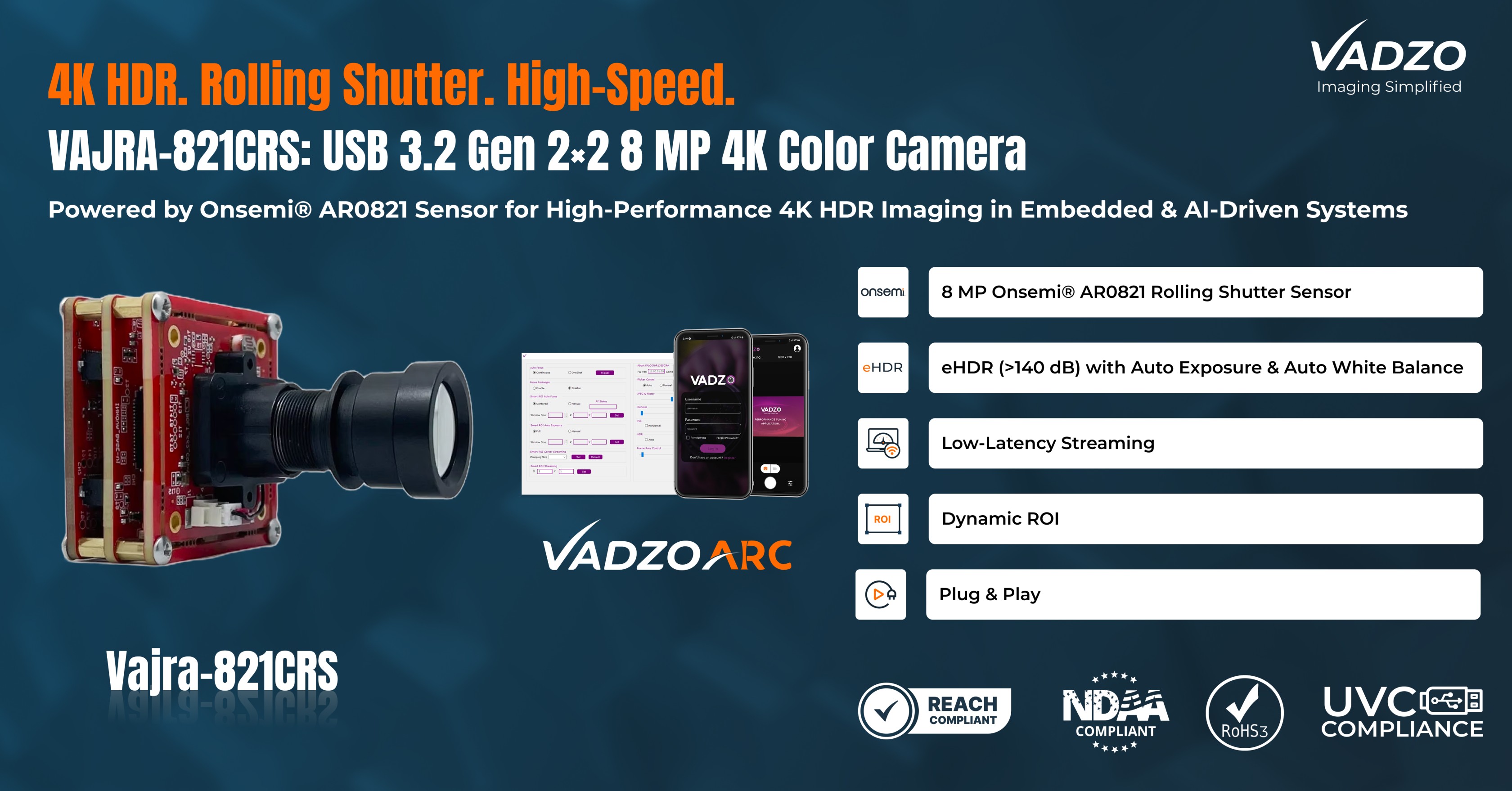
Onsemi AR0821 based 8MP USB 3.2 Gen 2x2 20 Gbps camera with 140 dB HDR targets industrial robotics, AGV/AMR systems, and edge AI deployments
FORT WORTH, TX, UNITED STATES, May 21, 2026 /EINPresswire.com/ -- Vadzo Imaging today announced the Vajra-821CRS, an 8MP 4K HDR USB 3.2 Gen 2x2 camera built on the Onsemi AR0821 CMOS image sensor. Integrating Vadzo's proprietary Vajra USB 3.2 Gen 2x2 architecture powered by the ultra fast dual-lane 20 Gbps interface. Built with interesting features such as embedded HDR exceeding 140 dB, and UVC-compliant plug-and-play operation, the Vajra-821CRS is purpose-built for industrial automation, robotics, AGV/AMR platforms, and edge AI vision systems where uncompressed 4K streaming, deterministic frame delivery, and high-contrast scene performance are required simultaneously.
Technical Highlights
Vajra USB 3.2 Gen 2x2 Architecture: The Vajra-821CRS integrates Vadzo's proprietary Vajra USB 3.2 Gen 2x2 architecture, enabling up to 20 Gbps bandwidth over a single USB-C cable via dual-lane operation. This supports uncompressed 4K video streaming with low system overhead and full backward compatibility with USB 3.2 Gen 1, ensuring the camera integrates into existing industrial and embedded computing platforms without infrastructure changes.
Deterministic Low-Latency Streaming : The USB controller operates in dual-lane mode to deliver deterministic low-latency video transmission — separating bandwidth availability from latency behavior so that frame timing remains predictable under load. This architecture is specifically relevant for robotics guidance, high-speed inspection, and embedded AI inference pipelines where variable frame latency causes downstream control errors.
8MP AR0821 CMOS Sensor with 4K Resolution: The Onsemi AR0821 sensor delivers 8MP resolution (3848 × 2168) in a 1/1.7″ optical format using a rolling shutter architecture with advanced pixel design. The sensor supports high frame-rate output for machine vision workloads requiring high spatial resolution without sacrificing throughput.
Embedded HDR Exceeding 140 dB: The AR0821's embedded HDR (eHDR) technology achieves dynamic range exceeding 140 dB, preserving detail simultaneously in bright and low-light regions within the same frame. This makes the Vajra-821CRS well suited for factory floors, outdoor monitoring, and smart infrastructure environments where fixed illumination cannot be guaranteed.
Advanced ISP and Automatic Controls: An onboard ISP provides Auto Exposure, including both centered and ROI-based AE, and Auto White Balance, maintaining consistent image quality across dynamic lighting conditions without manual adjustment. This reduces integration overhead for OEM deployments where cameras operate across multiple zones or shift patterns with varying ambient conditions.
Flexible Sensor Control and Dynamic ROI: The camera supports in-pixel binning, windowing, summing, and dynamic ROI configuration at the sensor level. These controls allow developers to increase frame rates, reduce bandwidth, and optimize processing load for application-specific workloads, particularly relevant for edge AI inference pipelines running on power-constrained embedded processors.
VISPA ARC SDK: The VISPA ARC SDK provides programmatic control over sensor parameters, dynamic ROI configuration, ROI-based Auto Exposure, hardware trigger and flash synchronization, binning, windowing, frame timing, and image tuning. Firmware configuration, camera management, and secure firmware update capabilities are included for lifecycle management in OEM production deployments. Supported languages: C, C++, C#, Python. Deployment platforms: Desktop systems, embedded processors, and edge AI platforms
Why USB 3.2 Gen 2x2 and How It Compares to CoaXPress, Camera Link, and 10GigE
The Vajra-821CRS delivers 20 Gbps over a single USB-C cable. For OEMs evaluating interface options for 4K machine vision deployments, this positions it against interfaces that have historically required dedicated hardware infrastructure to reach comparable bandwidth.
CoaXPress vs USB 3.2 Gen2x2 : CoaXPress 2.0 delivers 12.5 Gbps per coaxial cable, with multi-lane configurations scaling higher. The bandwidth is real — but so is the infrastructure cost. Every CoaXPress deployment requires a PCIe frame grabber installed in the host PC, adding hardware cost, a PCIe slot dependency, and a separate driver and SDK layer between the camera and the application. Specialized coaxial cables add further per-node cost. For embedded platforms, edge AI boxes, and compact industrial PCs without PCIe expansion, CoaXPress is not deployable without a hardware redesign. The Vajra-821CRS delivers comparable bandwidth over a standard USB-C cable to any host with a USB 3.2 Gen 2x2 port — no frame grabber, no PCIe dependency, no specialized cabling.
Camera Link vs USB 3.2 Gen2x2 : Camera Link achieves high bandwidth through parallel data lanes but requires a dedicated frame grabber, proprietary MDR or SDR cabling, and fixed cable lengths — typically under 10 meters at full speed. It has no standard power delivery over cable, meaning separate power must be routed to every camera node. Camera Link has no UVC compliance, no plug-and-play operation, and no viable path to embedded or mobile platforms. For any deployment outside a fixed factory installation with a full-size PC, Camera Link's infrastructure requirements make it operationally unsuitable.
10GigE vs USB 3.2 Gen2x2 : 10GigE Vision provides 10 Gbps over standard Ethernet cabling with genuine cable length advantages — up to 100 meters on copper, further on fiber. It supports IEEE 1588 PTP synchronization, making it the correct choice for multi-camera systems requiring frame-accurate synchronization across distributed nodes. However, handling full-bandwidth 10GigE traffic without frame loss typically requires a smart NIC or a frame grabber with protocol offload capability, reintroducing hardware dependency. The Vajra-821CRS at 20 Gbps exceeds 10GigE bandwidth by 2x, delivers deterministic frame timing via the USB architecture, and operates without a frame grabber or smart NIC on any standard USB 3.2 Gen 2x2 host.
USB 3.2 Gen 2x2 reaches bandwidth levels previously associated with CoaXPress and Camera Link, without frame grabbers, proprietary cabling, or PCIe slot requirements. It is the correct choice for deployments on embedded processors, edge AI platforms, compact industrial PCs, and AGV/AMR chassis where CoaXPress or Camera Link infrastructure cannot be accommodated. For fixed installations requiring cable runs beyond 10 meters or IEEE 1588 multi-camera synchronization across distributed nodes, 10GigE remains the more appropriate interface. For everything within standard USB cable reach where frame grabber-free integration, UVC plug-and-play, and 20 Gbps bandwidth matter, USB 3.2 Gen 2x2 is the practical choice.
Targeted Application Domains
Industrial Automation and Machine Vision: High-speed conveyor inspection systems require cameras that deliver consistent, distortion-free frames under mixed ambient and strobe illumination without frame timing jitter. The Vajra-821CRS deterministic low-latency architecture ensures frame delivery timing remains predictable under USB bus load, while eHDR at 140 dB preserves surface detail on both specular and matte parts in the same field of view — eliminating the need for separate illumination zones per material type.
Robotics and AMRs: AGV and AMR platforms operating in warehouses and mixed-use facilities encounter unpredictable lighting transitions, reflective floor markings, and high-contrast scene content that destabilizes standard camera exposure. The Vajra-821CRS 4K USB Camera ROI-based AE mode locks exposure to the navigational zone of interest rather than the full frame, maintaining reliable feature detection and barcode readability across lighting transitions. Dual-lane USB bandwidth ensures full-resolution frames reach the inference pipeline without downsampling.
Smart Infrastructure and Intelligent Devices: Smart parking, intelligent kiosks, telematics cameras, and digital signage systems require compact, high-resolution cameras that operate reliably across outdoor temperature ranges without active cooling. The Vajra-821CRS operating range of −30°C to 80°C and 38mm × 38mm footprint support direct board-level integration into space-constrained infrastructure enclosures, while UVC compliance eliminates driver dependencies across Windows and Linux platform variants.
Embedded Vision and Edge AI: AI inference pipelines on edge processors are bandwidth-constrained, running 4K uncompressed streams over standard USB 3.2 Gen 1 saturates available bandwidth and forces downsampling before inference. The Vajra-821CRS dual-lane 20 Gbps architecture delivers full 4K uncompressed frames to the host without bandwidth competition, allowing the inference pipeline to operate on full-resolution input. Dynamic ROI and binning controls allow developers to trade resolution for frame rate when the application requires higher temporal sampling over a sub-region.
Medical and Scientific Instrumentation: Diagnostic imaging, laboratory automation, and pathology devices require cameras that maintain calibrated, repeatable image output across extended operating sessions without drift. The Vajra-821CRS onboard ISP with stable AE and AWB algorithms, combined with deterministic frame timing from the EZ-USB FX20 architecture, supports consistent image-to-image repeatability for quantitative analysis workflows where frame-level luminance variation would introduce measurement error.
Frequently Asked Questions
What makes USB 3.2 Gen 2x2 relevant for 4K machine vision, and how does it differ from USB 3.2 Gen 2?
USB 3.2 Gen 2 provides a single 10 Gbps lane. At 4K resolution with 8-bit output at 30 fps, uncompressed bandwidth requirements approach or exceed this ceiling, forcing either compression artefacts or frame rate reduction. USB 3.2 Gen 2x2 doubles available bandwidth to 20 Gbps across two lanes over a single USB-C cable, providing headroom for full 4K uncompressed output at higher frame rates without the latency or artefact penalty of in-camera compression. For machine vision applications where pixel-accurate frame data is required for downstream measurement or inference, this distinction is operationally significant.
What does deterministic low-latency streaming mean, and why does it matter for robotics?
Standard USB camera implementations transfer frames in bulk or isochronous transfers where latency varies with bus contention and host scheduling. In robotics and motion control systems, variable frame latency means the control system cannot reliably correlate a captured frame to a known robot pose, introducing positional error into guidance and pick-and-place calculations. The USB 3.2 Gen2x2 architecture delivers frames with deterministic timing allowing the control system to use frame timestamps as reliable references for pose correlation.
When does embedded HDR at 140 dB matter versus standard WDR in industrial cameras?
Standard WDR implementations typically achieve 80–100 dB dynamic range through tone mapping of sequentially captured exposures, which introduces motion artefacts on moving subjects and increases processing latency. Embedded HDR on the AR0821 captures wide dynamic range within a single exposure at the pixel level, with no inter-frame motion between the short and long exposure components. At 140 dB, the camera maintains detail simultaneously on bright overhead lighting and dark conveyor surfaces without overexposing highlights or losing shadow detail.
Why choose USB 3.2 Gen 2x2 over CoaXPress or Camera Link for an embedded vision deployment?
CoaXPress and Camera Link both require PCIe frame grabbers that are incompatible with embedded processors, compact edge AI platforms, and AGV/AMR chassis. USB 3.2 Gen 2x2 connects directly to any host with a standard USB-C port, with no frame grabber, no PCIe slot, and no proprietary cabling. UVC compliance means the Vajra-821CRS is plug-and-play on Windows, Linux, and Android without driver installation, a meaningful operational difference for OEMs managing multi-platform deployments or field-deployed systems that require camera replacement without driver reconfiguration.
What customization options does Vadzo provide for OEM deployments of the Vajra-821CRS?
Vadzo supports OEM customization at hardware, firmware, and software levels. Hardware customization includes form factor, PCB layout, connector selection, and lens mount changes. Firmware customization covers ISP parameter tuning for specific illumination conditions, AE algorithm adjustment for application-specific exposure behavior, and trigger configuration for multi-camera synchronized deployments. Software customization is available through the VISPA ARC SDK across C, C++, C#, and Python. Evaluation kits and design-in assistance are available for production-bound OEM programs.
Availability
The Vajra-821CRS is available for OEM evaluation and production deployment. Engineering samples, evaluation kits, and detailed technical documentation are available at www.vadzoimaging.com. For volume pricing and OEM customization inquiries, contact support@vadzoimaging.com or call +1 817-678-2139.
About Vadzo Imaging
Vadzo Imaging designs and manufactures embedded and machine vision cameras for OEMs and system integrators. The company offers imaging platforms across USB, MIPI, GigE, and SerDes interfaces, with in-house development across sensor selection, optics, ISP tuning, firmware, and interface stacks, including UVC, Meridian (in-house ONVIF stack), and Vortex (in-house RTSP stack). Vadzo supports edge AI integration and provides OEM customization across hardware, firmware, and software for applications in industrial automation, robotics, smart surveillance, and life sciences.
Alwin Vincent
Vadzo Imaging
+1 817-678-2139
email us here
Visit us on social media:
LinkedIn
YouTube
X
Legal Disclaimer:
EIN Presswire provides this news content "as is" without warranty of any kind. We do not accept any responsibility or liability for the accuracy, content, images, videos, licenses, completeness, legality, or reliability of the information contained in this article. If you have any complaints or copyright issues related to this article, kindly contact the author above.
